Adam Empringham,
Director of Sales at Image Property.
South East Queensland Property Market: Steady Growth, Selective Conditions
Brisbane, the Gold Coast and the Sunshine Coast enter 2026 with strong fundamentals and a more measured pace than the urgency-driven years behind them. Demand is holding, supply remains tight, and the data points to a market shaped by long-term fundamentals rather than short-term hype.
According to the Cotality Monthly Housing Chart Pack (March 2026), national dwelling values rose 9.9% over the 12 months to February, the fastest annual pace since June 2022. But it’s the SEQ markets that continue to stand out.
Brisbane house prices in 2026: what the data shows
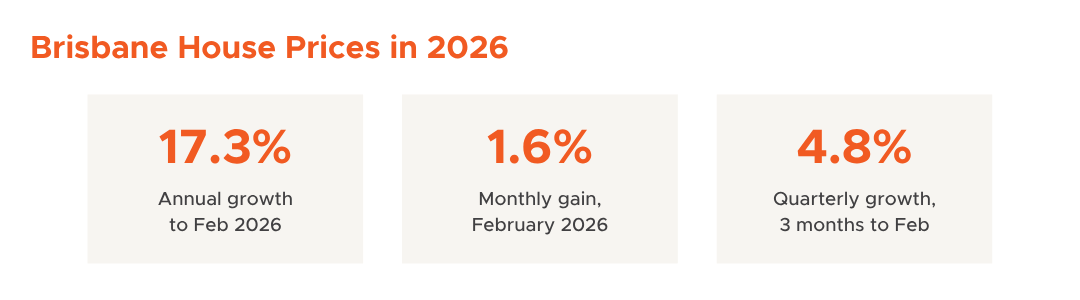
Brisbane dwelling values have risen 17.3% over the past 12 months to February 2026 and are currently at a record high with the strongest annual growth of any east coast capital city. The monthly gain in February alone was 1.6%.
Brisbane has remained one of Australia’s strongest property markets over the past three years. The latest Cotality data shows that this momentum is continuing, although at a more measured pace.
To put that in context, national dwelling values grew 9.9% over the same period, Brisbane is growing at nearly twice the national rate. Sydney managed just 6.0% and Melbourne 4.7% for the same period.
The drivers are well established: population growth from interstate and overseas migration, a chronic undersupply of new housing stock, and Brisbane’s relative affordability compared to Sydney. Total listings in Brisbane remain well below levels of a year ago, keeping upward pressure on prices.
Homes are selling in a median of just 21 days in Brisbane, among the fastest of any capital city, and vendor discounting is minimal at -2.5%, meaning sellers are achieving very close to their asking price.
Brisbane property market forecast: what to expect through 2026
The Brisbane property market is forecast to continue growing through 2026, supported by tight supply, strong population growth, and infrastructure investment ahead of the 2032 Olympics. Growth is expected to be more moderate than 2025 but sustained, with the market shifting from urgency-driven to fundamentals-driven.
Several structural factors point to continued price support through the year:
- Supply remains critically tight. Supply remains critically tight. Brisbane new listings are running 10% below last year’s levels, and total inventory is well below the five-year average nationally.
- Population growth is ongoing. Population growth is ongoing. Queensland continues to attract interstate migrants at above-average rates, adding sustained demand that new construction is not matching.
- The 2032 Olympics pipeline. The 2032 Olympics pipeline. Infrastructure investment Cross River Rail, Brisbane Metro, venue upgrades, is boosting liveability and long-term confidence in key corridors.
- Interest rates are a wildcard. Interest rates are a wildcard. The RBA have lifted the cash rate twice in 2026, the first increases since November 2023. Rate direction will influence buyer sentiment through the second half of the year.
- Buyers are more selective. Buyers are more selective. Well-priced, well-presented homes are performing strongly; overpriced listings are sitting longer.
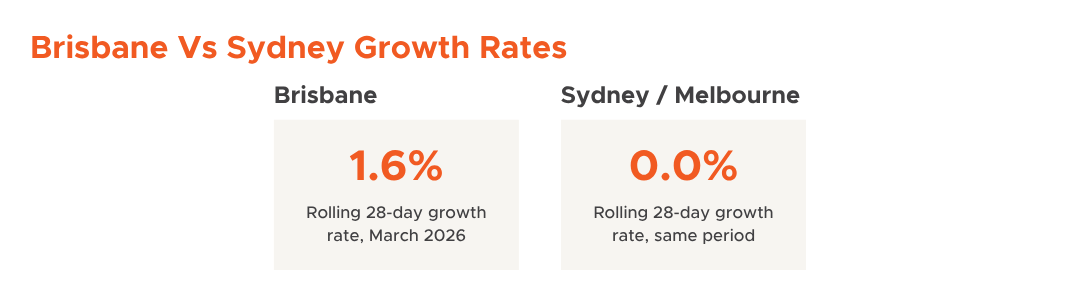
The two-speed dynamic playing out nationally also favours Brisbane. While Sydney and Melbourne have effectively flatlined with monthly growth of 0.0%, Brisbane’s rolling 28-day growth rate is tracking at 1.6%, second only to Perth among the capitals.
The outlook is for continued but more selective growth, with location, property type, and presentation playing an increasingly large role in outcomes.
Is Brisbane property a good investment in 2026?
For investors focused on long-term fundamentals, Brisbane continues to present a compelling case. Strong capital growth, rising rents, and yields above the national average make it one of the more attractive capital city markets in Australia right now, though the right property in the right location matters enormously.
Here’s what the numbers show for Brisbane investors right now:
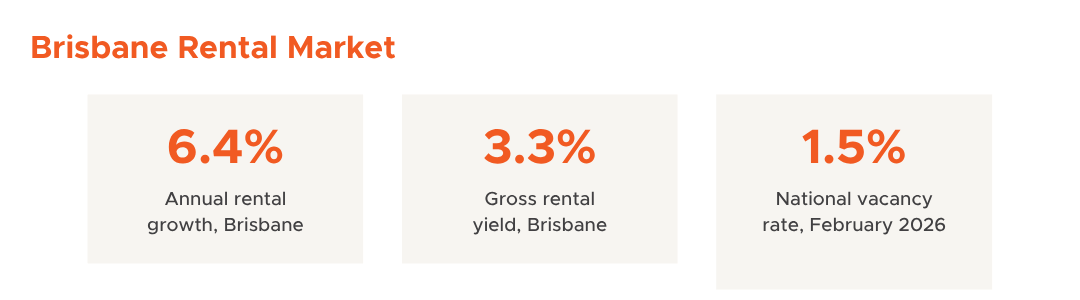
Rental vacancy nationally is sitting at just 1.5%, near record lows, and has been reaccelerating since mid-2025 after a brief slowdown. For landlords, this means strong demand and minimal periods of vacancy.
Investor lending nationally is up 23.6% year-on-year, which tells you where experienced money is moving. Queensland’s investor lending grew 24.4% annually, one of the strongest state figures in the country. This isn’t speculative activity; it reflects confidence in fundamentals.
The case for Brisbane investment rests on several pillars that aren’t going away soon: population growth, a housing supply shortfall, rising rents, infrastructure investment, and relative affordability against Sydney and Melbourne. Regional Queensland, which captures the Gold Coast and Sunshine Coast offers even higher gross yields at 4.1%, for investors willing to look beyond the capital.
The key caveat: investment performance in 2026 will increasingly depend on which property you buy and where. The market is becoming more selective. A well-located house near transport, schools, and employment will continue to outperform. Generic stock in oversupplied pockets will not.
Gold Coast: Stability and lifestyle-driven demand
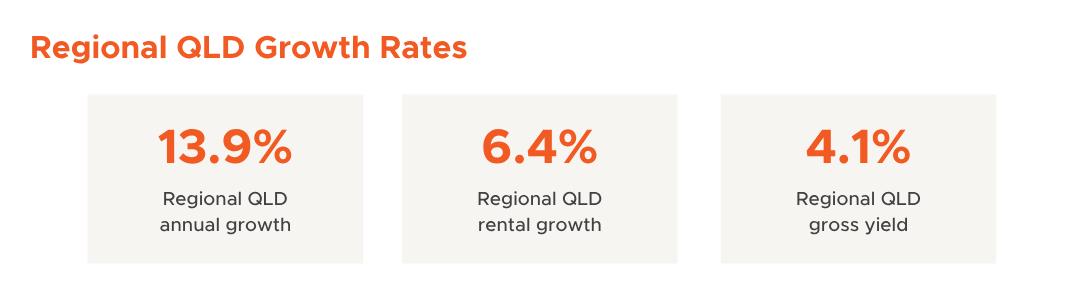
Regional Queensland, which captures lifestyle markets including the Gold Coast, recorded annual dwelling value growth of 13.9%, outpacing the combined capitals figure of 9.6%. Gross rental yields for regional Queensland sit at 4.1%, significantly higher than the 3.4% capitals average.
The Gold Coast has continued to show stability through the first quarter of 2026. Lifestyle appeal continues to be the central driver, suburbs offering a balance of accessibility, space, and coastal living are drawing consistent interest from families and downsizers alike.
Infrastructure investment, particularly in transport and amenity, is supporting longer-term confidence across key inland and coastal corridors. The market is operating in a more balanced phase: sellers who price realistically and present well are achieving good outcomes, while buyers have more time and choice than they did 12–18 months ago.
Sunshine Coast: Fundamentals unchanged
The Sunshine Coast has carried its momentum into 2026. While growth has eased from its peaks, the underlying story is unchanged: lifestyle migration, limited new supply, and a constrained rental market continue to shape the region’s trajectory.
Nationally, the rental vacancy rate sits at just 1.5%, near record lows, which is reaccelerating rental growth after a brief mid-2025 slowdown. For landlords and investors on the Sunshine Coast, this remains a supportive environment.
Family homes and well-located properties near schools, transport, and town centres are seeing the most consistent demand. The market is rewarding quality and location, a dynamic that suits the Sunshine Coast’s appeal to owner-occupiers and long-term investors alike.
Key themes shaping Q1 2026
- Growth continues, Growth continues, but at a more moderate pace, direction is unchanged, momentum has moderated.
- Supply remains critically tight nationally. Supply remains critically tight nationally. Total listings are 14% below last year and 17.8% below the 5-year average.
- Investors are active. Investors are active. Investment lending is up 23.6% year-on-year nationally. Rental demand remains strong with vacancy at record lows.
- Buyers are more selective. Buyers are more selective. Well-presented, realistically priced homes are outperforming. Presentation and location matter more than ever.
- Interest rates are a key watch. Interest rates are a key watch. The RBA lifted rates in February 2026 for the first time since 2023. Markets were pricing in another potential hike by June 2026.
The first quarter of 2026 reinforces the strength of South East Queensland’s property fundamentals. For those considering buying, selling or investing, understanding how broader trends translate at a local level and how timing, preparation, and local insight shape outcomes has never been more important.
Data source: Cotality Monthly Housing Chart Pack, March 2026. All figures to February 2026 unless stated. This article is for informational purposes only and does not constitute financial or investment advice.