What’s the difference between a sellers market and a buyers market?
If you’ve been following property news lately, you’ve probably heard both terms more than once. They get thrown around a lot, but what do they actually mean for you?
By Cameron Cullen, Director - Gold Coast
Published on July 14, 2026.
Last updated on July 14, 2026.
Understanding whether you’re operating in a sellers market or a buyers market changes everything about how you approach buying or selling a home.
The Simple Version.
A sellers market is when there are more buyers than there are homes for sale. Demand outpaces supply. When that happens, sellers tend to hold the upper hand. Homes sell quickly, offers come in at or above asking price, and buyers often have little room to negotiate.
A buyers market is the opposite. More properties are listed than there are buyers ready to purchase. Buyers have options. They can take their time, compare properties, and negotiate harder on price and conditions. Sellers may need to adjust expectations to get a result.
What Actually Creates These Conditions.
A few things drive the shift between one and the other.
Interest rates play a big role. When rates are low, more people can afford to borrow and the pool of buyers expands quickly. When rates rise, some buyers step back, which eases pressure on prices and creates more choice for those still in the market.
Population growth adds consistent demand. In SEQ, Queensland’s ongoing interstate migration has kept buyer numbers strong, even as borrowing conditions have tightened.
Supply is the other side of the equation. If new housing isn’t being built at the rate people are moving in, stock stays tight and conditions favour sellers. Brisbane’s total listings are currently sitting well below their five-year average, which helps explain why prices here have continued to climb even with rate rises.
How to Read the Market You’re In.
There are a few easy indicators to look for.
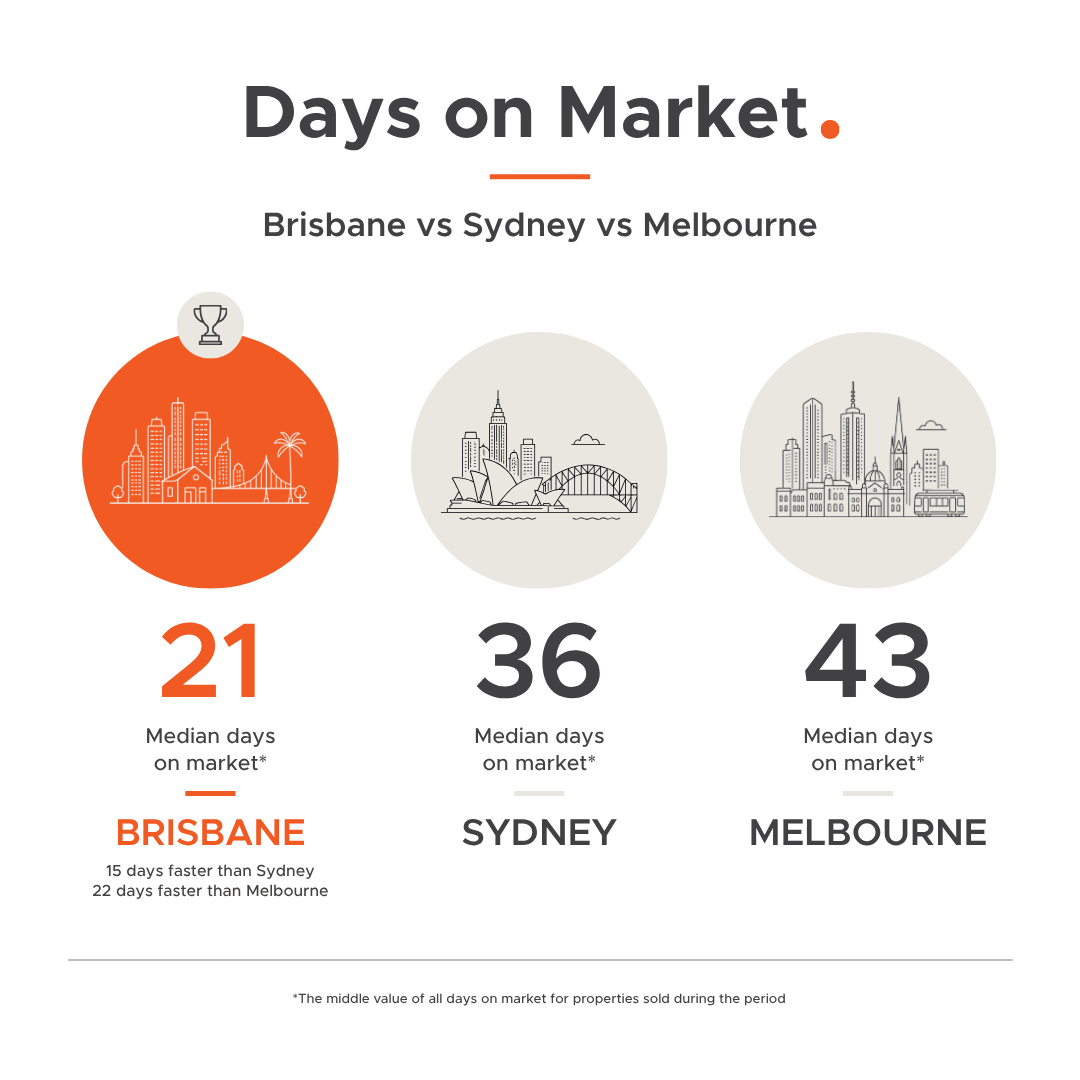
Days on market tells you a lot. In a sellers market, homes are selling in weeks, sometimes days. According to the Cotality Monthly Housing Chart Pack (March 2026), Brisbane’s median selling time is just 21 days. That puts it well ahead of the national capital city median of 28 days — and in sharp contrast to Sydney at 36 days and Melbourne at 43 days.
Brisbane is selling homes 15 days faster than Sydney and 22 days faster than Melbourne. That’s less than half the time it takes to sell in Victoria’s capital — a clear signal of where buyer demand is concentrated right now across the east coast.
Vendor discounting is another useful gauge. This measures the gap between what a seller lists for and what they actually accept. Brisbane’s vendor discounting rate sits at just -2.5%, meaning sellers are achieving very close to their asking price. A wider discount suggests buyers are negotiating down.
Listing volumes matter too. If you’re scrolling through property sites and there’s a lot of choice, conditions are shifting toward buyers. If you’re seeing the same handful of listings week after week, it’s a sellers market.
What It Means If You’re Selling.
In a sellers market, timing and pricing strategy still matter. Just because conditions are favourable doesn’t mean every home sells itself. Presentation, marketing quality, and the right price point all influence whether you achieve a strong result or leave money on the table.
In a buyers market, you need to work harder for the outcome. Competing with more listings means presentation and pricing have to be right from day one. Overpricing in a buyers market rarely ends well. Buyers will simply move on.
What It Means If You’re Buying.
A sellers market asks more of buyers. You need to be finance-ready, move quickly, and come prepared to make competitive offers. Spending too long deliberating on a well-priced home often means missing it entirely.
In a buyers market, you have more breathing room. You can compare properties more carefully, ask for longer settlement terms, or negotiate on conditions that might not have been possible 12 months ago.
Markets Are Local, Not National.
One thing worth remembering is that property markets aren’t uniform. A buyers market in one city can sit right alongside a sellers market two hours away. Right now, Brisbane is performing very differently to Melbourne or Sydney.
Even within a single city, conditions can vary significantly by suburb, price point, and property type. A family home near schools in a tightly held suburb may feel like a sellers market even when broader conditions are softening.
That’s why local knowledge matters so much. National headlines give you the broad brushstrokes, but the suburb-level picture is what determines your actual outcome.
The Takeaway.
Understanding market conditions won’t make you a perfect buyer or seller, but it does help you calibrate your expectations, time your decisions well, and avoid the common mistakes that come from misreading where things stand.
Speak to a Local Property Expert.
If you’re unsure about conditions in your area or want a clear picture of what’s happening locally, the team at Image Property is happy to talk it through.