Queensland's Population Growth Keeps Building. Housing Supply Still Hasn't Caught Up.
Almost 98,000 people were added to Queensland’s population in a single year. That figure, from the Queensland Government Statistician’s Office, covers the 2024 to 2025 financial year and works out at around 1.8%. That level of Queensland population growth puts the state ahead of the national rate.
By Joel Davis, Managing Director
Published on October 14, 2026.
Last updated on October 14, 2026.
Those people all need somewhere to live.
The past six months have been noisier than usual for anyone holding property in South East Queensland. Values have eased back from their February highs, listings have lifted, and the headlines have turned cautious. But the underlying pressure on housing has not gone anywhere, and for landlords, that distinction matters more than the monthly price movement.
Here is where the numbers actually sit.
The people keep arriving, just at a slower pace.
Queensland’s growth in 2024 to 2025 broke down three ways, according to the Queensland Government Statistician’s Office:
- Net overseas migration: 55,743 people, or roughly 57% of total growth
- Net interstate migration: 21,595 people, or around 22%
- Natural increase (births minus deaths): 20,606 people
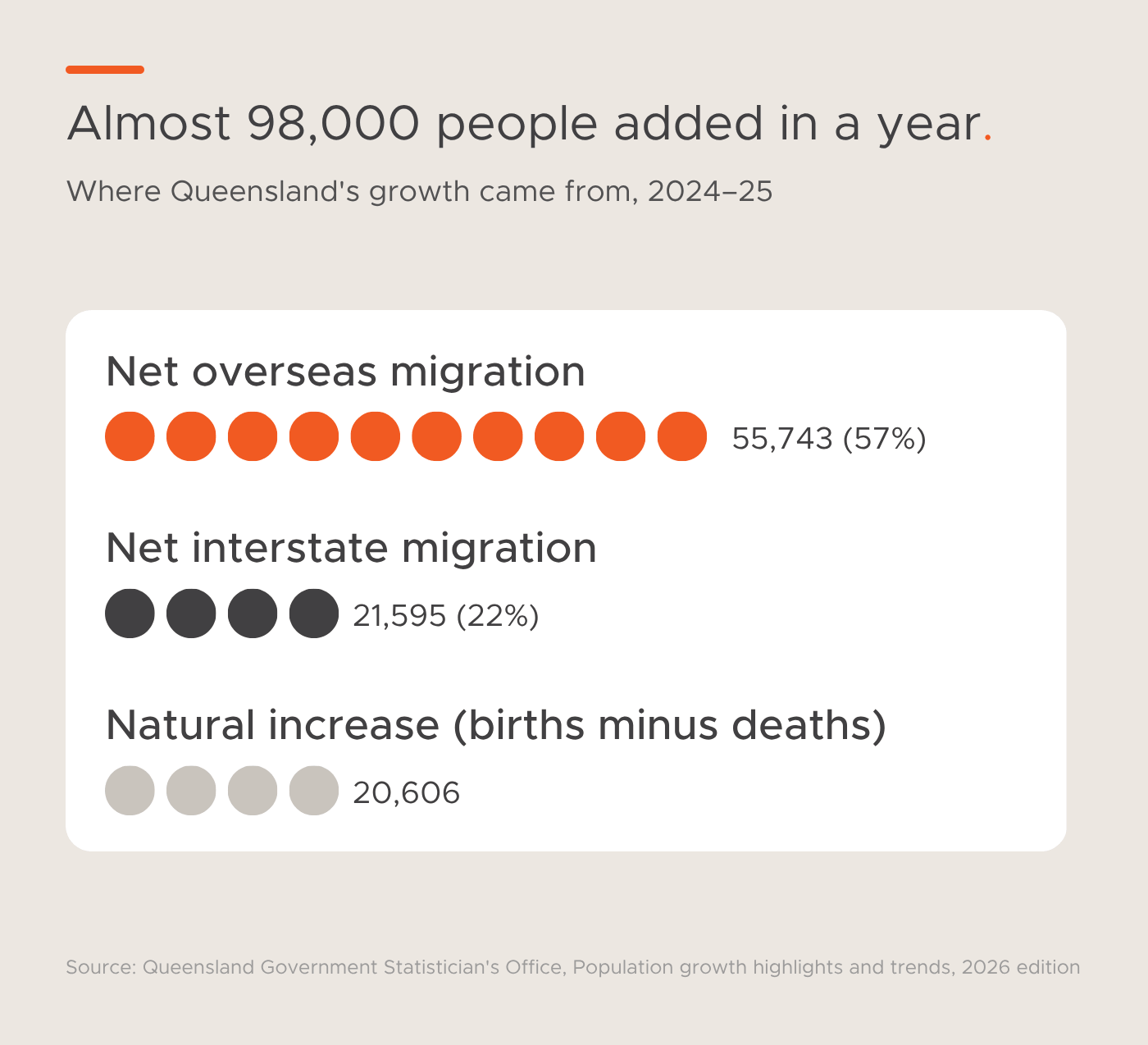
Both migration figures have come off their peaks. Overseas migration is down about 36% from the 2022 to 2023 high, and interstate migration has nearly halved since 2020 to 2021, when more than 40,000 people made the move north in a single year.
That is worth sitting with for a moment, because “slower growth” gets read as “no pressure”, and it isn’t the same thing. Queensland has recorded a net gain from interstate migration in every single quarter since June 1981. It is a 45-year run. The pace shifts with interest rates and border settings, but the direction has not changed in four decades.
Nationally, the Australian Bureau of Statistics put the population at 27.92 million at the end of March 2026, up 392,700 over the year. Queensland is taking a disproportionate share of that.
Values have steadied. The rental market hasn't.
This is the part that catches people out.
Brisbane dwelling values fell 1.0% in August 2026 and are down 2.7% over the quarter, according to Cotality’s September Home Value Index. The annual figure is still strongly positive at 10.8%, with a median of just over $1.08 million, but the momentum has clearly slowed. Nationally the picture is softer again, with values down 0.9% for the month and Sydney and Melbourne both going backwards over the year.
Total listings across the country are up 18.1% annually. Homes are taking a median of 39 days to sell, and vendor discounting in the capitals has widened to 4.2%, the largest gap in at least two years.
Now look at the rental side.
SQM Research had Brisbane’s vacancy rate at 0.9% in July 2026, against a national figure of 1.3%. The REIQ put Queensland’s statewide vacancy at 1.0% for the June quarter, with the Gold Coast easing slightly but still tight. Brisbane asking rents sat at around $756 per week across houses and units, up 8.3% over twelve months on SQM figures.
Gross rental yields have improved as a result. Cotality has the national gross yield at 3.8%, the highest since September 2019, with regional Queensland at 4.2% and Brisbane at 3.4%.
When capital values flatten and rents keep climbing, yields go up. That is exactly what has been happening.
Supply isn't keeping pace.
Queensland approved new dwellings at a trend rate of around 4,400 a month in July 2026, according to the Queensland Government Statistician’s Office. That is not nothing, but it is not matching a state adding close to 98,000 people a year either, and vacancy under 1% is what that looks like on the ground. REIQ chief executive Antonia Mercorella has been direct about where the fix has to come from:
“There is only one sustainable solution to housing affordability and rental pressures in Queensland, and that’s more housing supply.”
Antonia Mercorella, REIQ chief executive
Investors have been stepping back.
There is a second pressure on rental supply, and it doesn’t show up in approvals data.
Back in May I said investor confidence had taken a hit the moment the government began signalling cuts to negative gearing and the CGT discount. Our own numbers backed that up. Investors went from 28% of offers across South East Queensland to 22% in the space of a few months. People paused, hesitated, or withdrew altogether.
The mechanism from here is simple. If investors keep stepping back, vacancy tightens and rents rise.
If you already hold a rental property, that is not bad news in the short term. It is the same squeeze keeping vacancy under 1%.
What this means if you own property in South East Queensland.
A few practical things.
Your rental income is the more reliable part of the picture right now. With Brisbane vacancy under 1%, well-presented properties are still renting quickly. If you have a lease coming up for renewal, you have room to review the rent against current market evidence, within the limits of Queensland’s rent increase rules.
Don’t read the price softening as a market turning. A 2.7% quarterly dip after several years of strong growth is a correction in pace, not a collapse in fundamentals. The population pressure behind SEQ values is structural and slow-moving.
Selling conditions have genuinely changed. If you are thinking about exiting a property, the market you are selling into is not the one that existed in February. More stock, longer selling times, and wider vendor discounting all mean pricing and presentation carry more weight than they did.
Vacancy is your biggest cost. At current Brisbane rents, two weeks empty is roughly $1,500 gone. In a market this tight, that usually comes down to pricing, presentation, and how fast your property manager moves between tenancies.
Where this leaves you.
The story in South East Queensland has not really changed. More people keep arriving than there are homes being finished, and that gap has been holding rents up even while sale prices take a breather. The short-term noise and the long-term pressure are pointing in different directions, and it is worth being clear about which one affects your holding decisions.
If you’d like a clearer read on how your property is performing against current rents and vacancy in your suburb, the Image Property team looks after investors across Brisbane, the Sunshine Coast, and the Gold Coast. Get in touch for a rental appraisal and a straight conversation about where things sit.
Want to know how your property is really performing?
Our team looks after investors across Brisbane, the Sunshine Coast and the Gold Coast. Get a straight conversation about where your property sits.
This article is for general information only and does not constitute financial or investment advice.
Table of Contents
Agent Insight.
“Back in May I said investor confidence had taken a hit the moment the government began signalling cuts to negative gearing and the CGT discount.”

Joel Davis
Managing Director at Image Property